A Portland Photographer’s Compositional Guide
If you’ve spent any time shooting portraits in Portland — whether in a studio on the east side or chasing late-afternoon light through a Pearl District loft — you already know that the poses that feel the most authentic are rarely the ones you planned. That truth is at least 150 years old. Edgar Degas built an entire body of work around it.
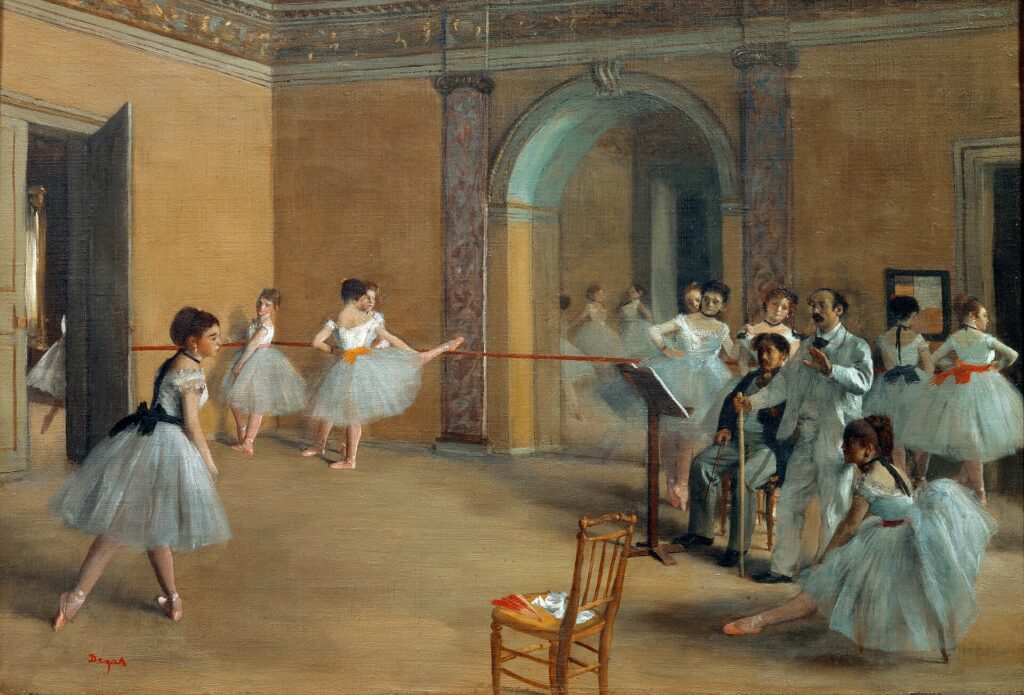
Degas was not interested in performance. He was obsessed with what happened before the curtain rose and after it fell — the rehearsal room, the wings, the quiet moment backstage when a dancer forgot she was being watched. His hundreds of ballet paintings and pastels were constructed not as celebrations of technique, but as studies in the body at rest, in transition, and in private. That distinction is the foundation of everything in this guide.
Why This Matters for Portland Portrait and Glamour Photography
The challenge every Portland photographer and creator faces is the same one Degas solved with charcoal and pastel: how do you make a posed image look unposed?
His answer wasn’t to stop directing. It was to direct toward function rather than form. He gave his subjects something to do — adjust a slipper, check a shoulder in the mirror, lean into a barre mid-exhale — so the body arrived at a natural, weighted position rather than a constructed one. The pose became a byproduct of an action, and the camera (or brush) simply caught it.
This is one of the most transferable principles in the entire history of Western figurative art, and it works just as powerfully in a Portland studio session as it did in the Paris Opéra in 1876.
Degas’s Core Lighting Logic — and How to Apply It in Studio
Degas was unusual among the Impressionists in his obsession with artificial light. While Monet and Renoir painted outdoors chasing sunlight, Degas worked indoors studying how gas lamps, hidden windows, and mirror reflections sculpted the body in ways natural light never could. His photographic sessions — which he conducted at dinner parties, arranging oil lamps and directing friends as models — confirmed his belief that lamp-lit figures emerging from darkness carry a psychological weight that flat daylight cannot replicate.
For a Portland studio shoot inspired by Degas, the lighting blueprint is specific:
- Single key source, 45 degrees to the side and slightly elevated — the same position Degas’s hidden studio windows occupied in paintings like The Dance Class. This creates one clean shadow along the far cheekbone and defines the collarbone, shoulder, and ribcage without harsh edges.
- Warm color temperature (3000–3500K) — Portland’s natural overcast light runs cool, which is beautiful for certain work but works against the amber warmth of Degas’s gas-lit interiors. A warm-toned softbox or LED panel at this range pulls skin tones into the honey and blush territory his pastels captured.
- No fill light on the far side — Degas allowed shadows to do compositional work. The dark side of a figure recedes into background, creating dimensional depth and drawing the eye along the lit contour of the body. A reflector used sparingly (silver, at distance) can hold shadow detail without killing the drama.
- Backlight or rim light optional but powerful — In works like L’Étoile (The Star), stage lighting from below and behind created an almost supernatural separation of dancer from background. A rim light placed low and behind the subject replicates this, outlining the shoulder, hip, and upper arm against a dark background in a way that feels both editorial and timeless.
The Diagonal as a Compositional Principle
Degas never photographed — or painted — a subject from dead-on. His viewpoint was consistently from a raised corner of the room, entering the space at an oblique angle. The large empty diagonal space running across his studio scenes was not emptiness — it was a compositional device that pulled the eye from foreground to background, creating depth and making figures feel placed inside a real space rather than staged against a backdrop.
For Portland portrait work, this translates directly:
- Position yourself off-axis — 30 to 45 degrees from your subject rather than squared-up. This creates three-dimensional dimensionality that flat-frontal shooting cannot achieve.
- Let one third of the frame breathe — don’t fill every corner with subject. Empty space in the foreground or mid-ground directs the eye and gives the composition room to move.
- Use architectural elements as diagonal leading lines — a doorframe, a barre, the edge of a mirror, a window — anything that enters the frame at an angle activates the same depth-creating geometry Degas used in every studio painting.
The Degas Pose Vocabulary: Directed Functional Movement
These are the specific postures distilled from Degas’s ballet work that translate most directly into photographic posing. The key to each: give your subject the action, not the shape. The shape will follow.
- The self-touch adjustment — Ask your subject to reach behind and adjust a strap, pull at the back of a bra closure, or smooth fabric at the hip. The result is a twisted torso, a raised elbow, and an organic line from shoulder blade to hip that no prescribed pose can replicate. Works exceptionally well in lingerie and boudoir work.
- The mirror check — Place a mirror at 45 degrees and ask your subject to check her reflection. The body turns slightly, weight shifts to one hip, one arm rises naturally, and the gaze goes somewhere other than the lens — creating intimacy without disconnection. This is one of Degas’s most repeated compositional moves and one of the most powerful in the Portland glamour photography toolkit.
- The waiting lean — Back or shoulder against a wall, barre, or doorframe. Arms loosely at sides or one arm crossed. One knee slightly bent, weight fully surrendered into the surface. Gaze anywhere: down, sideways, ceiling. This is pure Degas backstage — the body between performances, fully inhabited and fully unguarded.
- The floor sit — Legs tucked to one side (the classic Degas resting dancer position), one arm propped, body turned at an oblique angle toward camera. The floor position inherently creates relaxed body language, and the variety of leg placements — tucked, extended, crossed — generates multiple compositionally distinct images from a single setup.
- The mid-transition catch — Ask your subject to rise from seated, turn from one wall to another, or lower an arm from above her head. Shoot in burst throughout the movement. Degas built his entire practice on the conviction that the most expressive positions occur between the ones people intend to hold. This is equally true in studio photography — the frame just before or just after the “pose” is usually the one you’ll use.
Portland People-The PDXInspo Application
Portland people bring exactly the quality Degas was always looking for: authentic presence that doesn’t perform for the camera. The Pacific Northwest cultural sensibility — grounded, direct, unbothered by pretense — is actually a tremendous compositional asset when it’s paired with this kind of directed-natural approach.
The session structure that honors this: begin with the warmup task-based poses (adjusting, leaning, moving), shoot through the transitions, and let the formal composed images come after the subject’s body has found its own comfort and weight. You’ll find that by the time you ask for a held pose, the body already knows where it belongs in the frame
— because Degas showed us that the body, when trusted, always does.
